
If you’ve wondered what are AI marketing tools, you’re in the right place. I’ve spent years testing AI in real campaigns, from early chatbots to today’s predictive engines. AI marketing tools are software that use machine learning, natural language, and data models to plan, create, deliver, and measure marketing. They help you work faster, spot patterns, and make decisions with data, not guesswork. In this guide, I’ll break down how they work, what to use, and how to get results without the hype.
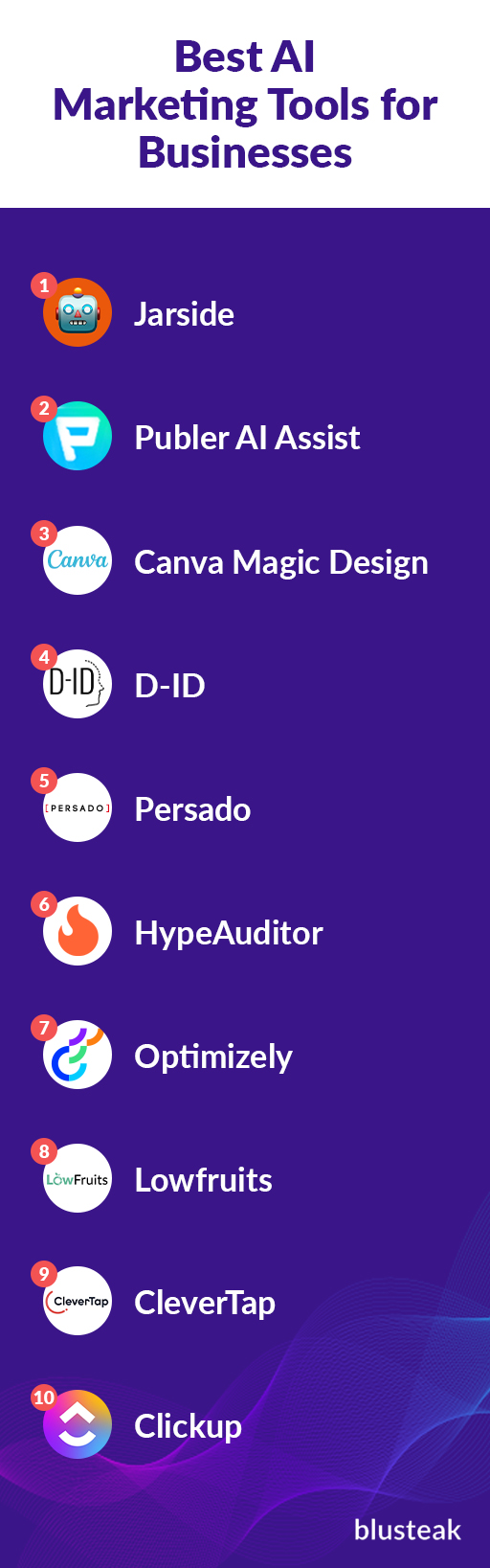
Source: blusteak.com
What Are AI Marketing Tools?
AI marketing tools are apps and platforms that use AI to automate or improve parts of marketing. They can write copy, score leads, personalize emails, plan ads, and even forecast sales.
You feed them data. They learn patterns. They make predictions or create content. You stay in control and decide what goes live.
Real-world example from my work: we used an AI subject line generator on a retail list. It tested variations in real time and lifted open rates by 18% without changing the offer.
Why they matter:
- They scale tasks you do daily, like content drafts or audience segments.
- They find small wins, like the best send time or bid, at scale.
- They tie actions to outcomes, so you can prove ROI with clarity.
How AI Marketing Tools Work
AI tools rely on a few core methods:
– Natural language processing. Helps tools understand and generate text for ads, blogs, or emails.
– Machine learning models. Learn from past performance to recommend budgets, audiences, or creative.
– Predictive analytics. Forecasts churn, conversion, and lifetime value for smarter targeting.
– Computer vision. Analyzes images and video for brand safety, product tags, and creative insights.
– Marketing mix modeling and incrementality tests. Estimate which channels drive impact.
Behind the scenes process:
- Data in. CRM, web analytics, ad platforms, email, and product data.
- Training. Models learn from clicks, purchases, and engagement.
- Action. The tool suggests next steps or automates them within your limits.
- Feedback. Results feed back to improve the model.
Tip from experience: start with clean tracking. Bad tags in, bad insights out.
Key Use Cases And Practical Examples
Top ways teams use AI today:
– Content creation. Drafts for blogs, social posts, ad copy, and meta descriptions.
– SEO. Topic clustering, outline generation, internal linking, and SERP analysis.
– Email and CRM. Subject line testing, send time optimization, and dynamic content blocks.
– Ads. Budget pacing, creative swaps, bid optimization, and audience expansion.
– Website and CRO. On-page personalization, product recommendations, and chat assistants.
– Analytics. Attribution hints, anomaly detection, and cohort insights.
– Sales enablement. Lead scoring, intent signals, and follow-up summaries.
From my campaigns:
- Ecommerce: AI recs raised AOV by 12% by showing bundles to high-intent visitors.
- B2B SaaS: Lead scoring trimmed SDR time by 25% while keeping win rates steady.
- Media brand: AI summaries helped ship daily newsletters in half the time.
Watch-outs:
- Always review drafts for brand voice.
- Set guardrails on ad budgets and bidding.
- Validate insights with experiments.
Benefits, ROI, And What To Measure
Clear benefits you can track:
– Time saved. Fewer manual tasks, more strategy.
– Higher conversion. Better targeting and creative testing.
– Lower CAC. Smarter bids and tighter segments.
– Better retention. Personalized lifecycle flows.
– Faster insights. Dashboards that flag issues early.
Core metrics to watch:
- Content: output per week, edit time, organic clicks.
- SEO: rankings for target terms, CTR, pages indexed.
- Email: open rate, CTR, revenue per send.
- Ads: ROAS, CPA, incrementality lift.
- Site: conversion rate, AOV, bounce rate.
- Lifecycle: churn, LTV, repeat rate.
Real ROI tip: attribute gains to a specific AI change. Use holdout groups or pre/post tests to confirm lift.
Popular Categories And The Ideal AI Stack
Common categories:
– AI writing assistants. Draft and refine content.
– SEO platforms with AI. Research, clustering, briefs, and internal links.
– Email and lifecycle AI. Subject lines, personalization, timing.
– Ad optimization AI. Creative rotation, bids, and budget pacing.
– Analytics and attribution AI. Forecasts, anomalies, and channel impact.
– Conversational AI. Chatbots, onsite help, and lead capture.
– Recommendation engines. Products, content, and bundles.
A simple stack to start:
- Content AI for drafts and briefs.
- SEO assistant for outlines and metadata.
- Email AI for subject lines and send time.
- Ad AI for budget pacing across channels.
- Analytics AI for weekly insights and alerts.
Rule of thumb from the field: one tool per job. Avoid overlapping features that fight each other.
How To Choose The Right AI Marketing Tools
Selection criteria:
– Fit to your goals. Tie each tool to one measurable outcome.
– Data and integrations. Check CRM, CDP, and ad platform connections.
– Ease of use. Test the workflow with your real content and data.
– Controls and transparency. Ask what the model can explain and what you can override.
– Security and compliance. Confirm data handling, retention, and access controls.
– Cost vs value. Pilot first, then compare impact to license and time saved.
Questions to ask vendors:
- What data does your model need, and who owns it?
- Can we turn off auto-apply and run human review?
- How do you measure incremental lift?
- How do you handle bias and hallucinations?
- What happens if we churn? Can we export everything?
Buyer tip: set a 90-day success plan with two KPIs. If it misses, cut or adjust.
Implementation Steps And Best Practices
A simple rollout plan:
– Start with one workflow. For example, email subject lines or ad budget pacing.
– Create a small test group. Hold out a control group.
– Set guardrails. Spend limits, review steps, brand voice rules.
– Train the team. Write prompts, create checklists, and define approvals.
– Measure weekly. Keep a simple dashboard with trend lines.
– Scale or stop. Expand only after you see stable lift.
Prompts that work:
- Give context. Audience, goal, channel, and tone.
- Set format. Word count, sections, or bullets.
- Share examples. Past winners, brand voice lines, and banned phrases.
Lesson learned: most failures come from vague prompts and no QA. Build a 10-minute review ritual.
Risks, Ethics, And Compliance Of What Are AI Marketing Tools
Key risks to manage:
– Hallucinations and factual errors. Always fact-check claims and numbers.
– Bias. Review outputs for fairness in segments and creative.
– Privacy. Respect consent, retention rules, and data minimization.
– Brand voice drift. Create style guides and enforce with checklists.
– Over-automation. Keep humans in the loop for final decisions.
Good practices:
- Use first-party data with clear consent.
- Limit sensitive attributes in models.
- Keep an audit trail for key decisions.
- Run regular bias checks on segments and copy.
- Educate your team on responsible AI policies.
Reality check: no tool removes accountability. You own the outcome, good or bad.
Future Trends To Watch
Where AI in marketing is heading:
– Multimodal content. Text, image, and video creation in one flow.
– Real-time personalization. On-site experiences shaped per visitor.
– Agentic workflows. Tools that plan tasks and execute steps across apps.
– Privacy-first AI. Smarter modeling with less personal data.
– Creative testing at scale. Thousands of micro-variations tested automatically.
What this means for you:
- Strategy and brand matter more. AI does the busy work, you set the direction.
- Data quality is the new moat. Clean, labeled data wins.
- Experimentation becomes nonstop. Build muscles for quick tests and fast learning.
Frequently Asked Questions Of What Are AI Marketing Tools
Q. Are AI marketing tools suitable for small businesses?
Yes. Start with content drafting, email subject lines, and basic ad pacing. These deliver quick wins without heavy setup.
Q. Will AI replace human marketers?
No. AI handles repetitive tasks and pattern spotting. Humans guide strategy, voice, ethics, and creative direction.
Q. How do I measure the ROI of an AI tool?
Tie it to one KPI, set a control group, run for 4 to 8 weeks, and compare lift against cost and time saved.
Q. What data do these tools need?
Usually CRM contacts, web analytics, ad data, email performance, and product catalogs. Clean data improves outcomes.
Q. Is AI-generated content safe for SEO?
It can be, if it is accurate, useful, original, and edited by humans. Avoid thin content. Add expertise and sources.
Q. How do I keep brand voice consistent with AI?
Create a style guide, share approved examples, add banned phrases, and require human review before publishing.
Q. What are common mistakes to avoid?
Starting too big, skipping QA, vague prompts, and not measuring incremental lift are the main traps.
Wrap-Up And Next Steps
AI marketing tools help you do more with less. They draft content, personalize journeys, and optimize spend while you focus on strategy and brand. Start small, set guardrails, and measure what matters. With a few focused wins, you can build a durable edge.
Try one workflow this week, like AI subject lines or ad pacing. Track results for 30 days. Share the learnings with your team and scale what works. Want more breakdowns like this? Subscribe, comment with your goals, or ask for a custom stack recommendation.
Watch This Video on what are ai marketing tools
>>> Get More Review Here: What AI Tools Specialize In Featured Snippet Optimization <<<