
An affiliate marketing agency builds and runs partner programs that grow sales fast.
If you want predictable growth without bloated ad spend, an affiliate marketing agency can be your secret engine. I’ve launched and scaled programs for startups and global brands, and I’ll show you how the right agency structures your program, manages partners, prevents fraud, and proves ROI. Read on for a clear, expert guide to choosing and working with an affiliate marketing agency that actually moves the needle.

What is an affiliate marketing agency?
An affiliate marketing agency is a team that designs, launches, and optimizes your partner program. They recruit publishers, creators, and brands who promote you for a commission on sales. They handle tracking, payouts, campaigns, and daily partner care.
Think of it like a sales force you do not have to hire. The agency finds and supports partners who already have the audience you want. This is different from an affiliate network, which is a platform and marketplace. The agency uses networks or SaaS tools, but stays focused on strategy and outcomes.
A good agency blends partner relationships, data, and creative. Their job is simple: bring you profitable, incremental revenue at scale.
How an affiliate marketing agency works
An affiliate marketing agency follows a clear cycle. It repeats each month with steady improvements.
- Strategy: Define goals, ideal partners, offers, and guardrails.
- Setup: Choose tracking, set terms, and build assets and landing pages.
- Recruitment: Pitch publishers, creators, and brands that match your niche.
- Activation: Give partners links, codes, briefs, and content they can use.
- Optimization: Test commissions, placements, pages, and product mixes.
- Compliance: Monitor policies, disclosures, and brand safety.
- Reporting: Share weekly and monthly insights with action items.
Most brands see early wins in 60 to 90 days. Strong growth comes from constant outreach and smart testing.

Why hire an affiliate marketing agency?
The right affiliate marketing agency compresses years of learning into weeks. They know which partners work by niche, how to avoid bad traffic, and how to price commissions. You get speed, scale, and structure without building a big in-house team.
- Faster partner access: Agencies have warm relationships and publisher teams on speed dial.
- Better ROAS: Affiliate is often a top channel for return on ad spend.
- Lower risk: Pay for performance, not for impressions that may not convert.
- Focus: Your team stays on product while experts grow the channel.
- Experience: Avoid common mistakes that burn time and trust.
From my work with retail, SaaS, and subscription brands, the biggest win is focus. When an affiliate marketing agency leads the program, confusion drops and revenue grows.

Core services an affiliate marketing agency provides
Most agencies offer a full stack of services. Ask for clear deliverables and owners.
- Program design: Commission models, tiers, rules, and partner fit.
- Platform setup: Network or SaaS tracking, pixel or server-to-server.
- Recruitment: Prospect lists, outreach, follow-ups, and onboarding.
- Creative: Banners, product feeds, briefs, and link strategy.
- Campaigns: Seasonal pushes, new launches, and content roadmaps.
- Optimization: A/B tests, placements, and partner tiering.
- Compliance: Policy enforcement, ad monitoring, and disclosure checks.
- Finance: Payouts, invoice flow, and tax docs through the platform.
- International: Currency, language, and regional publisher mixes.
- Cross-channel: Sync with SEO, paid social, and email calendars.
Ask your affiliate marketing agency to map each service to KPIs and weekly tasks.
Pricing models and typical budgets
Costs vary by size and complexity. The model should match your goals and risk profile.
- Monthly retainer: A flat fee for management. Common for steady growth and complex programs.
- Performance fee: A percent of revenue driven. Aligns incentives with outcomes.
- Hybrid: Lower retainer plus performance fee. This is popular and balanced.
- Setup fee: One-time cost for platform, terms, tracking, and creative.
- Tool fees: Networks or SaaS tracking charge separate platform fees.
Many brands start with a hybrid and a 3 to 6 month ramp. Your budget should also cover partner placements and bonuses during key seasons.

Tech stack and tracking basics
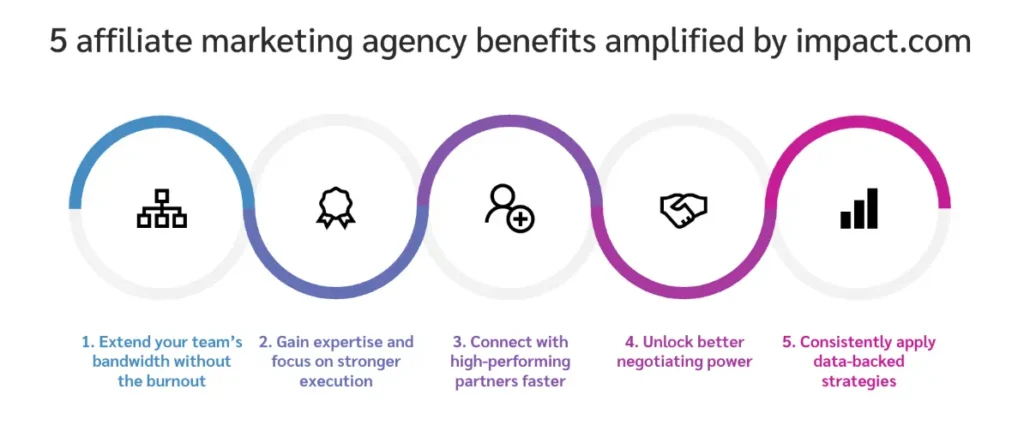
Your affiliate marketing agency will help you choose the right stack. The choice depends on your niche, volume, and data needs.
- Networks: Provide tracking, payouts, and a marketplace of partners.
- SaaS platforms: Offer deep control, custom rules, and flexible reporting.
- Tracking methods: First-party cookies, server-to-server, and conversion APIs.
- Data feed: Keep product data clean, fresh, and tagged for content partners.
- Deep links: Drive users to the right product or category.
- Mobile: Use SDKs or deep linking to capture app installs and sales.
Privacy is changing fast. Ask your agency how they handle ITP, cookie limits, and signal loss. Server-to-server and consent modes help keep tracking accurate.
Compliance, fraud prevention, and brand safety
A strong program is safe and clean. Your affiliate marketing agency should lead here.
- Clear terms: Coupon rules, PPC rules, and brand guidelines.
- Disclosure: Enforce FTC-compliant disclosures on content and social.
- Monitoring: Track ad placements, keywords, and brand mentions.
- Fraud checks: Watch for bots, click spam, typosquatting, and fake leads.
- Data rules: Follow GDPR, CCPA, and data minimization best practices.
- Clawbacks: Reverse orders on returns or fraud with clear timelines.
Set rules early. Enforce them always. It builds trust with good partners and protects your brand.
KPIs and reporting that matter
Focus on a few core metrics. Review weekly, and decide on one change per week.
- Revenue and orders: Core business outcomes.
- ROAS and CPA: Efficiency of the channel.
- AOV and conversion rate: Health of traffic and offers.
- EPC and RPM: Partner-level earning power.
- Active partners: Who drove at least one sale this period.
- Partner mix: Content, coupon, loyalty, creator, and B2B balance.
- Incrementality: Lift tests and holdout insights.
Ask your affiliate marketing agency for a living dashboard. It should include trends, insights, and next actions, not just numbers.
How to choose the right affiliate marketing agency
Pick fit over flash. The best partner will know your niche and your buyer.
- Vertical experience: Ask for case studies in your category.
- Partner access: Check their relationships with key publishers and creators.
- Tech fluency: Make sure they can work with your stack or suggest one.
- Fee structure: Understand all fees, including network and partner costs.
- Team strength: Meet the actual account team, not just sales.
- Process: Ask for a 90-day plan with weekly milestones.
- Reporting: See sample dashboards and post-mortem reports.
- References: Talk to active clients in similar stages and sizes.
- Contract terms: Clear exit, data ownership, and IP rights.
Smart tip: Run a paid audit first. Let the affiliate marketing agency review your data and pitch a plan. You will see how they think before you commit.
A 90-day plan with an affiliate marketing agency
Use this simple timeline to launch or fix your program fast.
- Weeks 1–2: Strategy, terms, tracking, and creative. Build prospect lists.
- Weeks 3–4: Outreach starts. Onboard first partners. Launch baseline offers.
- Weeks 5–6: Activate content partners. Test deep links and landing pages.
- Weeks 7–8: Secure placements for next month. Add creator affiliates.
- Weeks 9–10: Optimize commissions by partner type. Tighten rules.
- Weeks 11–12: Scale winners. Plan seasonal pushes. Ship a quarterly report.
Keep meetings short. One weekly stand-up, one monthly deep dive. Make one to two changes per week. That pace compounds.
Real-world lessons from the field
Here are a few hard-won insights from my work with an affiliate marketing agency setup across brands.
- Recruitment is a funnel: Send more invites than you think. Expect slow ramp. A warm follow-up beats a cold pitch.
- Commission tiers matter: Pay more for top placements and new customer sales. Do not overpay for last-click coupons.
- Briefs win deals: Share clear angles, hero products, and deadlines. Publishers love easy wins.
- Landing pages convert: A fast, focused page can double conversion with the same traffic.
- Protect search: Set rules for PPC bidding on branded terms. It saves budget and avoids cannibalization.
- Pay on time: Fast, fair payments make you a partner of choice. Word travels fast in this space.
These small habits separate average programs from top performers.
Trends shaping affiliate marketing in 2025
The channel is growing and changing. Plan for these shifts with your affiliate marketing agency.
- Creator affiliates: Short-form video and live shopping drive intent and trust.
- B2B partner programs: SaaS and fintech lean on partner-led growth.
- Content commerce: Media brands blend editorial with commerce at scale.
- Privacy-first tracking: Server-side and modeled conversions keep data flowing.
- AI partner discovery: Faster outreach and better partner fit using AI.
- App and omnichannel: Mobile, in-store, and subscription tie-ins grow share.
Brands that blend content, creators, and classic affiliates will win the next wave.
Frequently Asked Questions of affiliate marketing agency
Q. What does an affiliate marketing agency actually do day to day?
They recruit partners, manage offers, track results, and keep the program compliant. They also run tests, secure placements, and report on growth.
Q. How long before I see results with an affiliate marketing agency?
Many brands see first sales in 30 to 60 days. Strong, steady growth usually shows by 90 days with active recruitment.
Q. What budget do I need to start?
Plan for platform fees, an agency fee, and partner commissions. A small test can start modestly, then scale as you see profitable sales.
Q. Do I need an affiliate network to work with an agency?
Not always. You can use a network or a SaaS platform. Your affiliate marketing agency will advise on the best fit for your goals.
Q. How is affiliate different from influencer marketing?
Influencer is often paid upfront for reach. Affiliate pays for performance. Many creators now blend both with trackable links and codes.
Q. Can affiliate marketing hurt my brand if mismanaged?
Yes, if rules are weak or partners are unchecked. A good affiliate marketing agency prevents fraud, protects your search terms, and enforces policies.
Q. What KPIs should I watch first?
Start with revenue, ROAS, and conversion rate. Then track partner mix and active partners to ensure sustainable growth.
Conclusion
An affiliate marketing agency can turn partner marketing into a strong, low-waste growth channel. With the right strategy, clean tracking, steady recruitment, and tight compliance, you can build a program that compounds month after month.
Take one step today. Define your goals, shortlist three agencies, and ask each for a 90-day plan. When you find the right fit, commit to the process and watch your partner flywheel spin up. Want more guides like this? Subscribe, share your questions, or leave a comment about your current affiliate challenge.